Generally, it is necessary to collect the information of inverters, electricity meters, surge protection (security), anti-island device and so on, which requires a 4G Internet of Things gateway. Hangzhou Ling-Qi Internet of Things Gateway supports various brands and models of inverters, electricity meters, surge and anti-island devices, and is equipped with 4G Internet of Things gateway and cloud platform, which supports remote monitoring and alarm push and facilitates remote maintenance and supervision.
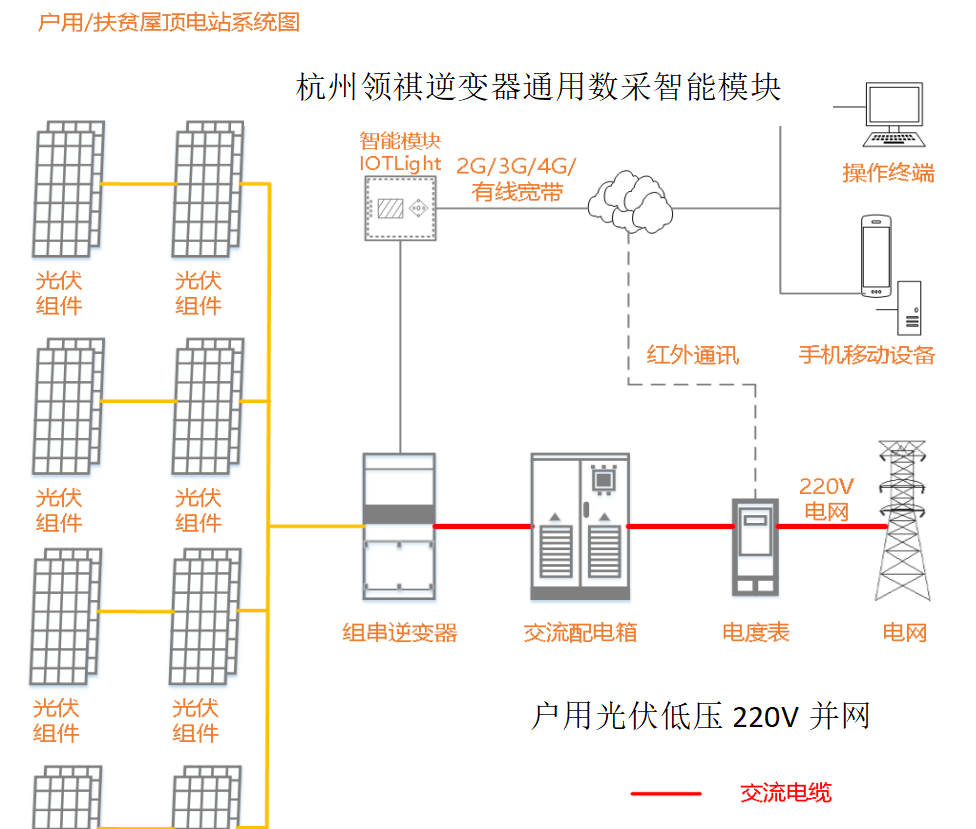
According to the installation situation of different households in different areas, it can judge whether the photovoltaic panel works normally and whether the inverter works normally. It can provide safety protection and automatic alarm, and let the owners know the income situation in real time on their mobile phones. It can also centrally manage and maintain the situation of all contracted households' power stations in the jurisdiction, reducing the project cost of maintenance and inspection.
According to the criteria of the Wind Energy and Solar Energy Evaluation Center of the National Meteorological Administration, China's solar energy resource areas are divided into the following four categories:
First class area (resource rich belt) : annual radiation in 6700~8370MJ/m2. Equivalent to 230kg of standard coal burning heat. It mainly covers the Qinghai-Tibet Plateau, northern Gansu, northern Ningxia, southern Xinjiang, northwestern Hebei, northern Shanxi, southern Inner Mongolia, southern Ningxia, central Gansu, eastern Qinghai, and southeastern Tibet.
Second class area (rich belt of resources) : annual radiation in 5400 ~ 6700MJ/m2, equivalent to 180 ~ 230kg standard coal burning heat. It mainly covers Shandong, Henan, southeastern Hebei, Southern Shanxi, northern Xinjiang, Jilin, Liaoning, Yunnan, northern Shaanxi, southeastern Gansu, southern Guangdong, southern Fujian, north-central Jiangsu and northern Anhui.
Three types of areas (resource general belt) : annual radiation in 4200 ~ 5400MJ/m2. Equivalent to 140 ~ 180kg of standard coal burning heat. Mainly in the middle and lower reaches of the Yangtze River, parts of Fujian, Zhejiang and Guangdong, spring and summer are rainy, and autumn and winter solar energy resources are ok.
Four types of areas: annual radiation dose below 4200MJ/m2. It mainly includes Sichuan and Guizhou provinces. This district has the fewest solar energy resources in our country. The first and second class areas, with annual sunshine hours no less than 2200 hours, are the areas with abundant solar energy resources and good resource conditions for the utilization of solar energy, and are the key utilization areas of photovoltaic projects.
Distribution facilities and connecting points
Distribution equipment is one of the bases for choosing grid-connected scheme of photovoltaic power station. The main contents are: transformer capacity, transformer ratio, quantity, busbar, load ratio, etc
Factory metering meter location, number of distribution cabinets, busbar specifications, switch models, etc.
Whether the factory is equipped with a relatively independent distribution room, if not, whether there is a spare room or open space for the transformer and distribution equipment; Whether the power distribution device has a free interval. If not, whether the bus bar can be crimped.
Preference is given to users with large total transformer capacity and large load proportion.




 0086-18958100293